Apologies for the length of this one, but sometimes to relay a proper story requires, well, telling the story properly. Diane has been wanting me to write it out, so here goes…
If I risked injury to my brain by thinking about it too hard, I may be able to conjure up a rough description of most of the bikes I’ve had since I learned to ride, which my mother says was at three years of age. I do remember the experience of learning to ride, but I don’t remember the bike very well. My first 10-speed road bike I think was a used Panasonic with 24” wheels, and I was well under ten years old. I was probably about twelve when my dad bought me my first “adult” bike that could really go places, a 25-inch Schwinn World road bike, with 12-speed indexed shifting on the stem and 630-32 tires. Around 1986 or so, I recall it costing about $220. I was riding a lot and already into fixing bikes, so it wasn’t long before I was upgrading parts as needed, teaching myself to rebuild wheels, but it would always be a fairly low-end bike. It did what I needed, and I rode it everywhere, over the mountain roads and around the lakes where I grew up, often 40-65 miles at a time, usually exploring alone.
Where I grew up was about 15-20 miles northwest of the Serotta Sports facility at the time. I vaguely knew of Serotta, as the high-end bike maker who happened to be in my backyard, but I was a kid riding a value Schwinn. Mentioning Serotta was like discussing Lamborghini; so untouchable that it wasn’t worth considering, beyond reading a rare review or catching a glimpse of this mythical beast in the wild. I also didn’t know what I didn’t know.

Of course I read cycling periodicals religiously as a teenager, like Bicycling Magazine, Bicycle Guide, and Road Bike Action. I’d buy a Winning! off the newsstand, if only to follow Greg LeMond, but otherwise I didn’t pay much attention to racing. In those magazines I might see the occasional mention of Bontrager or Klein, and I knew of Miyata and Specialized from advertising, but our local bike shops sold Giant, Ross, Raleigh, Schwinn, and perhaps Cannondale. That’s what we knew.
Presumably because of one of these subscriptions, I landed on the mailing list of a sport shop in Glens Falls and received from them a solicitation to their Open House Weekend event, which included an invitation to test-ride a Serotta. Was this even for real? I would have been approaching seventeen at this time in 1991. It was mid-June, and my parents readily agreed that as a family we would drive over there after church on Father’s Day.
My little brother says he went inside too, but I remember our mom and sister waiting outside in the van while my dad and I went into the store. There were Bridgestone bikes on the floor, and a little Serotta merchandizing stuff, but the shop mostly specialized in winter skiing, and over against one wall Serotta’s national sales manager was conducting fittings on a Size Cycle, then sending riders out on a demo bike. Just waiting around for this level of individual attention was unnerving but, eventually, it was my turn…
Unlike the other testers, who were fully kitted-out, I was a kid, wearing casual shorts, t-shirt, and sneakers. When the Serotta rep asked me to hop up on the fitting machine my dad started to panic. “Whoa, whoa, whoa! We’re not taking home a two-thousand-dollar bike today!!”
The rep gently replied, “No, no… I get it… It’s no problem. The boy is here to ride a Serotta, yes? Well, that’s what I’m here for too, so we’re just going to fit him up to ensure he gets the best experience. This is what we do, and how we do it.”
My dad looked on nervously as the Serotta guy took measurements, made adjustments, asked questions, and made further adjustments to the machine. He then sketched a quick drawing of my fit parameters, and discussed with a mechanic which demo could be adjusted most appropriately. They settled on a black and purple Davis Phinney model, made a few tweaks, and changed pedals to accommodate my sneakered feet.
They sent me out around a few blocks, accompanied by a shop employee who scolded me immediately when I started out of the parking lot. “A fine bicycle is not a horse! You should never mount a bike that way!!”
Doh! I’m not even out of the parking lot, and already in trouble! Well, it’s not my bike, so I guess I need to ride it the way he says. His reprimand however had no lasting effect on my spirits after the instant I took that first pedal stroke.
Now, I had reasoned that an expensive bike was probably nicer than a cheap bike, but nothing could have prepared me for the experience of a bike so high-strung that it seemed alive, shivering with a desire of its own to launch like a rocket with my slightest input. I could only imagine what the bike might do if this shop employee wasn’t reigning us in. I already had a bike that propelled forward when I pushed on the cranks, but this thoroughbred just wanted to bolt, so effortlessly! A bike is a bike, right? How is this even possible? After a quick ride on city streets, I was soon wheeling back through the shop’s door.
The Serotta rep asked what I thought, but he knew we weren’t going to buy a bike that day. I thanked him by instead purchasing a bright red-with-yellow Serotta jersey. This was my first piece of technical apparel, and would remain my only jersey for several years. Before leaving they also gave me a couple posters of Davis Phinney, commemorating his recent achievement as the US National Champion, 2nd place finish, leading the Coors Light cycling team.
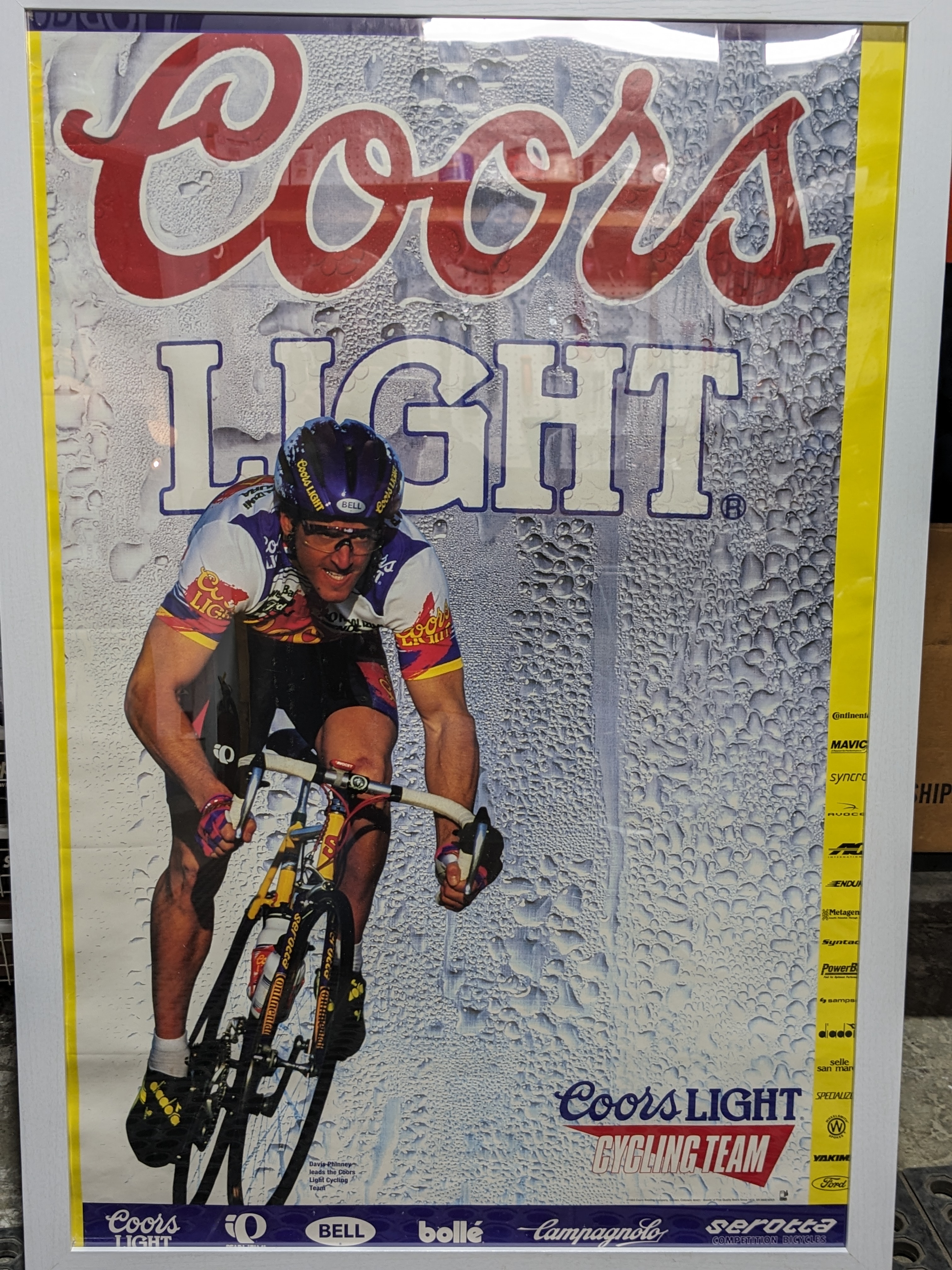
Upon climbing back into the family van, my mom asked me how it went. I said simply, “Someday… I will have one.” There wasn’t much more I could say that would make sense.
She replied, “I am sure you will.”
Now that I had ridden something so impressive I was aware of my own bike’s shortcomings, and so I saved up for the best bike I could afford, an aluminum Trek 1200. About a year-and-a-half later, in 1993, I started working at my local bike shop where I had bought my Trek. My boss had an older Serotta he had raced hard, and still rode occasionally. We were not a stocking dealer, but we had delivered a few custom bikes, and now I was getting paid to overhaul an occasional Serotta.
In early 1998, after college, I joined Diane at Hubbub in Cleveland, and quickly learned of her long history selling many, many Serotta bicycles in northeast Ohio. As half of Hubbub now, and the only mechanic, I was regularly working on Serottas when those bikes she had sold over the years came in for service. We were not selling Serotta anymore, but we still have the same Serotta Size Cycle to fit each client for their new custom bike.
A couple of these Serottas were my size, but I’m tall and inflexible, so most were not. I got to care for them regularly, usually annual overhauls, or at least seasonal service, and occasionally building new wheels or accommodating fit changes. One in particular belonged to a local gentleman named Paul. We looked forward to his visits; not just to work on his Serotta, but he’s always softspoken and kind. We hope we’ve done our best to take care of all our customers but, let’s face it, business involves personalities on both sides of the counter. Some folks you get along with a little better than others, and Paul is someone we always enjoyed. He purchased his Colorado II from Diane in 1991, and I became the bike’s mechanic in 1998.
By this time I was surrounded by exceptional bicycles, all day, every day, and Serotta is but one of many. Over the following seasons we’re selling some of the finest bikes made, mostly Calfee, Co-Motion, Seven, and Waterford. A few years later I bought an exquisite custom Waterford of my own, and we’re mostly riding our tandem anyway, so my burning need to possess a Serotta was long forgotten. Then, a few years after that, I finally started fabricating steel frames myself. While I haven’t made very many, I do strive to achieve a level of craftsmanship with each one that holds its own place in this world of top-of-the-line bicycles. Now that I have a collection of Ferraris, Porsches, Bentleys, Astin Martins, and McLarens, acquiring that Lamborghini I had coveted isn’t the priority it once was, especially since I can make one for myself now.
Somewhere in that time Paul decided to replace his Serotta with a modern production carbon bike from a more typical bike shop. We didn’t see him or his Serotta anymore because the bike no longer needed service. Shortly after we closed our retail Chesterland location, and I moved to the industrial space in Kirtland in 2013, I received a phone call from Paul. He said, “I know you’ve always been taken with my old Serotta, and it’s in our basement collecting dust. I don’t think I’ll be riding it anymore, so I’m wondering if you’d like to buy it.”
I had just splurged at an opportunity to add an Eisentraut and a stunning USA Masi to my collection, so the timing of his call was not ideal for my budget. I replied, “If you really must sell it, then I’ll figure something out, but if you’re willing to hold onto it, it’s a magnificent bike and there might come a day when you want to take it out to enjoy it again, even if briefly. It belongs to you, and you don’t need to let it go. If and when you decide to sell, I would very much appreciate first right of refusal.”
He said, “You know what? I like that idea. I’ll keep it for now, and let you know if I change my mind.”
Since then, we encountered him at a rest stop on an organized ride in Kentucky once, I think around 2016 or 17. We ride our tandem with radios in our helmets, so I overheard their interaction from a distance when Diane reminded him that I had not forgotten about his Serotta, and he said that he had not forgotten either. Over the years since came the pandemic, blah, blah, blah, all leading up to 2022 when I was prompted to move my workshop out of Kirtland, and into my newest location in Beachwood.
Moving and single-handedly building out my new shop space over the 2023 season made for another challenging year, but I had a vision, and eventually pulled it off. It’s not 100% yet, but then again it probably never will be. Part of that vision has been to display cool bikes overhead, particularly the more interesting of my own modest collection. Wouldn’t it be super nifty if Paul’s Serotta was hanging up there too?
Over the summer of 2023 this was something I could barely consider, as all my spare attention and resources were focused on framing, drywalling, and painting, mostly at 12-16 feet above the floor of my new shop. Adding more bikes was not a priority. It was part of the vision that kept me going however, so I couldn’t help but think of it occasionally. It had been many years since I’d heard from Paul, and didn’t have his contact information handy, so at some point during the summer I dug through my old files and found his details. I never reached out, because I wasn’t yet prepared to do anything about it, but I did add his contact info to my phone and started writing his name on the occasional daily To-Do List… to do, someday.
About one week before Christmas we were relaxing at home around 9:30 in the evening when my phone rang. Paul’s name flashed up on the screen as the caller. Shocked, I answered the phone and exclaimed, “How are you!” while Diane tried to discern from my side of the conversation who it was. We chatted for a few minutes before he informed me that, indeed, the time had arrived to finally let his Serotta go. We chatted a little longer as I brought him up to speed on my new location, his fortuitous timing, and how the bike might fit into my vision for the shop.
He eventually interrupted by saying, “I know that nobody will appreciate this bike as you can, and I’m calling to say that I really just want you to have it.”
I believe it was from the sound of my jaw hitting the floor that Diane finally deciphered who I was talking to. To recap… The bike is my size, and with some of my favorite old parts hanging on it. It was built in 1991, sold by Diane at the same time when I first rode the Davis Phinney model that most directly influenced my fascination with exquisite bicycles. I have been the only mechanic to work on the bike since 1998, and it was owned by one of my favorite people. Paul still had the original catalogue and sales slip, including Diane’s handwriting. Oh, and that jersey I bought upon the occasion of my Serotta test ride back in 1991… It’s a few sizes too small now, but I still have it… The bike’s paint scheme happens to be an exact match.

I eagerly look forward to riding it this season, and I’m incredibly grateful to have it displayed above my desk at work, with the jersey and my framed posters of Davis Phinney, all matchy-matchy, all from 1991.
 Hubbub Bicycles